

.svg)
.png)
Free-flow tolling charges vehicles as they travel, without requiring them to stop at a toll booth or barrier. Cameras and sensors identify each vehicle as it passes, calculate the toll and trigger payment or invoicing. For busy crossings, this removes the need for toll plazas and the queues they create. It also shifts much of the work from the roadside to the systems that process each crossing afterwards.
Key facts:
- Free-flow tolling identifies and charges vehicles at highway speed, without a physical stop or toll plaza.
- Multi-lane free flow (MLFF) applies tolling across all lanes simultaneously, rather than restricting it to a dedicated lane.
- Vehicles are identified through number plate recognition, electronic tags or a combination of both. The resulting record is matched to an account or used to generate an invoice.
- With no barrier to prevent unpaid crossings, enforcement depends on the systems that identify non-payment and manage the follow-up. Weak integration between toll collection and enforcement can leave revenue uncollected, even when vehicle detection is accurate.
How it works
Gantry-mounted cameras and sensors capture vehicles as they pass, using number plate recognition and, where applicable, electronic tags to establish their identity. The system also classifies the vehicle, for example as a car, van or HGV, so the correct toll can be applied. The crossing record is then matched to an account or vehicle registration, the charge is calculated, and payment is collected or an invoice issued.
How does detection and classification work?
The system needs to identify each vehicle reliably and assign it to the correct charging category. A van recorded as a car, for example, may be charged at the wrong rate every time it crosses. Across a busy road, those errors can accumulate into a significant revenue shortfall.
Maintaining accuracy at highway speeds requires consistent performance across every lane and direction, throughout the day and night. Cameras and sensors must also cope with changing light, rain and other conditions that affect the quality of captured data. Small weaknesses in detection or classification become harder to manage as traffic volumes increase.
How is payment matched to the right vehicle?
Once a vehicle has been identified, the crossing record needs to be linked to a payment account, a registered number plate or an invoice. This process must keep pace with traffic volumes, ensuring charges are calculated and recorded promptly and that exceptions can be investigated without building up a backlog.
At Tyne Tunnel, more than 10,000 payments are processed daily, a practical example of the transaction volumes a tolling system needs to handle reliably in live operation.
How is non-payment enforced without a barrier?
Without a physical barrier, vehicles can pass through without paying at the time of crossing. The tolling system must therefore identify unpaid journeys, distinguish genuine non-payment from processing delays and pass the relevant records into the enforcement process.
If those stages are poorly connected, unpaid crossings can remain unresolved even when the original vehicle was detected correctly. The issue may not become apparent until outstanding charges are reviewed, by which point the operator may be dealing with a substantial backlog of cases that need investigation and follow-up.
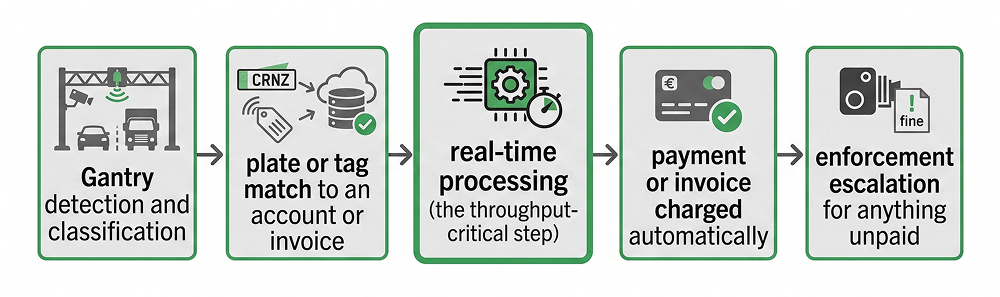
Multi-lane free flow tolling (MLFF)
Multi-lane free flow (MLFF) applies tolling across every lane of a road, rather than directing vehicles through a dedicated tolling lane. It's commonly used on motorways and major river crossings, where channelling traffic into a single lane would reintroduce the congestion that free-flow tolling is designed to remove.
The challenge is tracking each vehicle accurately as traffic moves across multiple lanes. Land Passage tracks and classifies vehicles across all lanes simultaneously, including those changing lanes as they approach a gantry, so crossings aren't missed or counted twice.
Electronic toll collection
Electronic toll collection (ETC) covers tolling systems that replace cash and manual payment with electronic methods, including tags and number plate recognition. Not all ETC systems are free-flow: some still require vehicles to stop or slow down at a toll point, even if payment is handled electronically.
Free-flow tolling and MLFF are specific applications of ETC that allow vehicles to continue moving through the tolling point. The distinction matters when comparing systems, as electronic payment alone doesn't remove the need for a physical toll point. The table below explains how the terms differ.
Bridge and tunnel tolling
Bridges and tunnels concentrate traffic at a fixed crossing, making them well suited to free-flow tolling. Every vehicle passes through the same location, but without reliable detection and follow-up, operators can still lose revenue from unpaid journeys.
The Tyne Tunnel is an established example of free-flow tolling in live operation. Land Passage has processed more than 10,000 payments daily at the crossing, providing a practical example of the system handling sustained transaction volumes. See Land's roads, tunnels and bridges deployments.
Toll enforcement and evasion
At a conventional toll barrier, a driver who doesn't pay can be stopped before leaving the toll point. With free-flow tolling, the vehicle has already passed, so the operator must identify the unpaid crossing, establish the registered keeper and pursue payment afterwards. Repeated non-payment may lead to escalating penalties, depending on the applicable rules.
This makes enforcement a critical part of the tolling operation. Accurate detection is only useful if unpaid crossings are identified and followed up. Without a reliable process linking crossing records to enforcement, outstanding charges can accumulate without being resolved.
Land Passage brings detection and enforcement into the same platform, helping operators manage unpaid crossings without relying on a separate process to pick them up later.
Proof point
Tyne Tunnel (TT2 Ltd) is the only tunnel beneath the River Tyne, carrying tens of thousands of journeys each day. TT2 replaced its legacy toll infrastructure with a digital, barrierless system powered by Passage. ANPR identifies vehicles across both tunnel bores, with more than 10,000 payments processed daily.
The system has maintained 99.5%+ uptime since go-live and processes more than 21 million journeys annually, without service interruption or the need for manual fallback. TT2 selected Passage through a competitive tender, with throughput, uptime and enforcement integration among the requirements for operating at this scale.
Considerations
- Can the system identify vehicles accurately at highway speed across every lane, without requiring traffic to slow down?
- What happens when a vehicle can't be identified? Is there a process to resolve the record, or does the crossing go uncharged?
- Is enforcement integrated with toll processing, or does it rely on a separate system and manual follow-up?
- How does detection accuracy hold up at actual traffic volumes, including at night and in adverse weather?
- How are classification errors, such as a van recorded as a car, identified and corrected? How frequently do they occur?